
Frequently Asked Questions
- Why are 3 pads better for Antifreeze Coolant Testing?
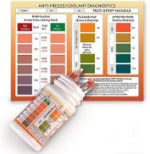
- Often is heard in the service lane I do not know which type of antifreeze coolant is in my vehicle. So, we developed a test strip to help test all the automotive coolants. Regular testing with ACUSTRIP test strips enables the consumer to identify issues early. Concentration often varies as antifreeze coolant as evaporation and topping off occurs. Topping off a concentrate, 50/50 blend of dissimilar technology fluid, distilled water or (not recommended), tap water are common service issues. The level of concentration identifies if the fluid is out of line with the desired freeze / boil point protection level. Adjustment for the desired concentration is recommended after the condition of the coolant is evaluated. 2 different test points are offered for the condition of the coolants, RA (Reserve Alkalinity) and pH. RA is a measure of the buffering power that is in the fluid to protect against corrosion. Typically, the newer (OAT) coolants can be identified by their lower level of RA. IF the RA is low and the pH is low (less than 6.5) then service is recommended. If the RA is low, and the pH is 6.5 and above the coolant does not require service. If the RA is higher then it may contain conventional coolant or a mixture of conventional coolant. If enough RA is indicated the coolant does not need service and the pH is expected to be in the mid-range area of 6.5-10. Having these 3 measures covers all the antifreeze types, and provides in 1 dip and read information to help make a service decision.
- Is the 32.5% urea solution (DEF) critical?
- Yes, the 32.5% urea concentration is the ideal solution as it provides the lowest freeze point. Also, SCR systems will be calibrated to the 32.5%, so that optimum NOx will be reduced during operation.
- What is the freeze point of DEF?
- A 32.5% solution of DEF will begin to crystallize and freeze at 12 deg F (-11 deg C). At 32.5%, both the urea and water will freeze at the same rate, ensuring that as it thaws, the fluid does not become diluted or over concentrated. The freezing and unthawing of DEF will not cause degradation of the product.
- What is the effect of antifreeze coolant (glycol based) contamination in engine oil?
- Antifreeze coolant (glycol based) reacts with the lubricant base stock and additives to cause oil thickening and acceleration of oil oxidation and sludge formation.
- I have a shop that performs fluid services. What is the return on investment that I can expect with the test strip programs?
- Customers don't appreciate leaving a shop only to have something else break down soon after. By adding a little time while the customer is waiting, anywhere from 7 to 15 minutes, technicians can inspect each vehicle for areas that may need service. When findings are presented professionally customers will give you the go-ahead to make the repair while their car is on-site. With professional and scientific looking reports a service area can decrease the number of vehicles processed each day while increasing sales, and customer satisfaction, leading to referrals, return business and reduced marketing costs. Studies show that by providing a $20 perceived value inspection to the customer they achieve a 65-70 ROI and a 50% reduction in comebacks.
- Can I add tap water to antifreeze coolant when mixing concentrate to add to my system? Can it be used to top off my system?
- No, we don't recommend using water of unknown quality for your vehicle. Distilled, DI, soft or other treated water can be used as long as the water quality complies with ASTM/TMC recommendations. You can check the quality of your water with your local municipalities or you can use ACUSTRIP CTS/5 Water Quality test strips to test the quality of your tap water at home.It is further suggested if the antifreeze coolant system in your vehicle is low, to verify the condition of your antifreeze coolant with ACUSTRIP ACUTEST 1, check for leaks and top off your system with ready-to-use 50/50 coolant/antifreeze and water mixture, manufactured by a reputable supplier.
- Do Acustrip test strips require an SDS?
- Occasionally our customers will request a Safety Data Sheet (SDS) for their file. While we do provide SDSs for many of our products, Acustrip tests strips do not dissolve and are under an exception from these requirements. Specifically, Acustrip test strips are classified as an "article" under CFR1910.1200 (b)(6)(v), and paragraph (c). The strips may release trace amounts of a hazardous chemical (as defined in paragraphs (d) and (g) of the section) but do not pose a health risk to employees. As a result, our strips DO NOT require SDS sheets. With less than 1% active ingredients, and a non-dissolving medium, Acustrip test strips are considered very safe.
- How do I maintain Supplemental Coolant Additives (SCA)?
- Supplemental Coolant Additives are vital for the health and longevity of any diesel engine. Acustrip provides test strips to monitor your coolant system for adequate SCA. To learn more about monitoring your SCA or to use the SCA Calculator, please see our Supplemental Coolant Additives page.
- How is freeze point affected by mixing with EG antifreeze coolant?
- The relationship of freezepoint depression is shown by this graph. Up to a point the freeze point is lower (70%) and then it rises.
- What are some of the common causes and effects of poor coolant?
- There are a wide variety of causes, effects and solutions of problems that might occur with your antifreeze coolant system. Indeed, there are more than we can list here. Please review the Coolant Cause-Effect Chart (pdf - 6K).
- Why do I need to measure the freeze point of the antifreeze in my car?
- A 50/50 blend of Antifreeze and water will provide freeze protection to -34 degrees and boil over protection to 257 degrees Fahrenheit. In colder areas of the US protection against block freezing is well known. With the higher efficiency and operating temperatures of vehicles, providing adequate boil over protection to prevent the loss of coolant and potential overheating and engine seizure is a must. Please review the Coolant Chart for Maintaining 50% Antifreeze (pdf - 10K).
- Why do I need to check the condition of my Antifreeze Coolant?
- The leading cause of radiator failure is corrosion due to lack of cooling system maintenance. The corrosion inhibitors in conventional antifreeze gradually deplete over time, so the recommended coolant change interval has traditionally been every two years or 24,000 to 30,000 miles with regular preventive maintenance to check level and condition.
The new "extended service" antifreeze that can go 5 years or 150,000 miles between changes with regular preventative maintenance for checking the level and condition, reduce the need for cooling system change and can reduce the risk of premature radiator failure.
Checking the pH and RA of the coolant with chemically-treated test strips can help determine the condition of the coolant. The alkalinity of a typical antifreeze/water mixture will vary depending on the additive package in the antifreeze The pH also, depending on the coolant, will vary with conventional coolants around 9 and long life coolants around 8. A pH strip such as the ACUSTRIP ACU1550 Series that measures both long life and conventional coolant should be used to prevent false readings. - Why do I need to test the nitrite?
- In order to combat cavitation problems, some vehicle manufacturers install coolant system filters, which not only filter the coolant, but also have nitrite in the filter media. By servicing the coolant filter at certain intervals, the nitrite in the system should always be constant. When running a coolant filter, the use of an SCA is not necessary. This would only increase the concentration of nitrite, causing other problems.
The ideal amount of nitrite in a diesel cooling system is around 800 ppm (parts per million). If levels drop below this the protection of the cylinder liners is compromised. However, if the concentration of nitrite is greater than 800 ppm, other things are compromised. Sometimes greater concentrations of nitrite can cause the O-rings that seal the liners to deteriorate.
Most truck repair facilities monitor the nitrite level to ensure reliability of the coolant system and the effects it may have for future repairs. Acustrip provides test strips for both conventional and red extended life (NOAT) coolants that easily test the condition of coolant including the nitrite levels. - What results would I expect if I used the test strip in an Ethylene Propylene Glycol mixture?
- The results will be less than 1 color block conservative. Ethylene Glycol provides slightly higher freeze protection at like concentrations, and therefore contributes to a lower freeze point protection. Differences of less than 1 color block will result.
- What results would I expect if I used the test strip in an Ethylene Glycol mixture?
- The results will be less than 1 color block conservative. Ethylene Glycol provides slightly higher freeze protection at like concentrations, and therefore contributes to a lower freeze point protection. Differences of 1 color block will result.
- Does Antifreeze do anything other than provide protection from freezing and boil over?
- Antifreeze coolant has several uses. Foremost is its ability to help remove heat from an engine. Antifreeze and water have been used extensively since the 1950's as a heat transfer fluid due to its low cost plentiful supply, and easy and safe handling. This excellent article on coolant fundamentals explains the role that properly maintained coolant plays in protecting your engine.
- What ways are there to measure freeze point?
- In order of expense and difficulty of use, the lowest to highest are:
- Test strips
- Hydrometer
- Refractometer - Can I use Antifreeze by itself?
- Antifreeze by itself has an insufficient boil over and freeze protection ability. Mixture with water provides the Freeze protection and boil over protection.
- Can I use water by itself?
- Water by itself is very corrosive and does not have the freeze and boil over protection that an engine requires.
- What is corrosion?
- Water by itself is corrosive to metals. The most familiar corrosion is rust. Rust develops as metals come in contact with air and water. Corrosion occurs with the other metals in a cooling system, copper, iron, aluminum etc. A good antifreeze coolant has an inhibitor package to protect against corrosion.
- How do I know if my antifreeze is protecting the engine against corrosion?
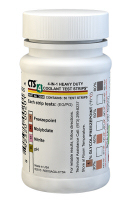
- The easiest way to test antifreeze for corrosion protection is with test strips. According to the article, Coolant Fundamentals, there are a variety of coolant components that protect against corrosion. Acustrip manufactures a variety of coolant test strips that can determine if the coolant, both conventional and OAT, is corrosive and has life left to protect the engine. These strips include the ACUSTRIP CTS-4 (Nitrite, Molybdate, Freeze Point and pH), the ACU-R071 Series (for extended life coolants), and the ACU3100MR Series (Nitrite, pH and Freeze Point for NOAT systems).
- How does the RA color change pad compensate for the different concentration (mix) of EGW? If I have a 20/80 mix of EGW it seems like the RA indication would be different than if I have a 50/50 mix of EGW.
- Please note that the the strip responds to the ability of the sample to resist a pH change; so does the standard RA titration. As such, the strip reacts to the condition of whole solution, not just the components.
- What are OAT-based Coolants and How do I Test Them?
- Organic Acid Technology (OAT) is an extended life coolant that typically uses sebacate and 2-EHA (2-ethylhexanoic acid) as corrosion inhibitors. DEX-COOL, which is orange in color, is one such OAT coolant. Hybrid Organic Acid Technology (HOAT) combines traditional corrosion inhibitors such as as silicates or phosphates with OAT coolant. Valvoline's Zerex is a HOAT coolant which is a low-silicate, phosphate free formula that includes the benzoate inhibitor. Nitrite Organic Acid Technology (NOAT) is a type of OAT coolant that uses a carboxylate base formulation with nitrite and molybdate added as corrosion inhibitors. NOAT is suitable for heavy-duty applications. ACUSTRIP provides test strips for each of the various OAT coolants. In addition to the ACUR071 and ACUR132 Series, ACU1550 and ACU3000-NOAT test strips are suitable for testing OAT-based coolants.
- How does a test strip work?
- Immersion momentarily into a water and antifreeze solution, of a chemically treated pad on the end of an inert plastic strip. The pad caries a pH indicator, a buffering agent, and a color reagent correlated especially to the various concentrations and freeze points of antifreeze containing solutions.
- How accurate are the test strips?
- In a blind field test of over 200 people using antifreeze and water dilutions of 25, 33, 40, 45, 50 and 60%, approximately 90% of the readings by the test strip as interpreted by the people in varying levels of light were within 10 degrees of the refractometer readings.
- Why are there some thinner tests trips in the bottle of test strips?
- Each bottle of test strips contains the quantity of strips notated on the bottle. Due to the strip slitting process, it is normal to find one or two additional strips that are noticeably smaller or larger in width than the normal strips in the bottle. These should be discarded.
- Does the test strip work in hot Antifreeze?
- In comparative tests in hot Antifreeze (70 to 90 degrees centigrade) it was determined that the color development is faster, and therefore the reading will be one color block darker than the reading of the cooler Antifreeze.
- What temperature should the A/F be in order to get the best readings?
- For best results the antifreeze coolant should be between 70 and 80 degrees Fahrenheit. At lower temperatures the color development is slower, and at higher temperatures the color development is faster. Antifreeze warmer than 100 degrees Fahrenheit is not safe to handle.
- Can I test the A/F in the overflow bottle?
- It depends on the level in the overflow tank. Generally if there is sufficient liquid in the overflow bottle it is representative of the antifreeze coolant mixture in the vehicle. However if you just added additional 100% antifreeze to the overflow container, or if the level is very low, it would not be indicative of the mixture in the cooling system.
- Is the technology covered by a patent?
- Yes, the original one was, 3,973,909 expiration date 8/10/93. The method is based on technology used in medical analysis of urine. It was developed to assist people with diabetes to determine what treatment they needed. ACUSTRIP Company, Inc. has improved the test strip's sensitivity, accuracy, and readability in Ethylene Glycol, Propylene Glycol, and OAT type coolants, to assist maintenance professionals and consumers determine what treatment Heavy or Light Duty coolant systems need.
- What is the shelf life of the test strips?
- Test strips in foil packages are guaranteed for 1 year from date of manufacture. Test strips in the bottle packages are guaranteed to work 2 years from date of manufacture. Test Strips should be stored at room temperature. Do not store the test strips in direct sun light. Once the bottle is opened, the bottle should be stored at room temperature with the bottle cap tightly closed. Avoid handling the test strips with wet and/or oily hands.
- How can I tell if the test strip is still good?
- The pad will be a brown color versus the white to light yellow that a fresh pad will have.
- What do I do with the used test strip?
- Test strips are to be disposed with normal paper waste. They are not hazardous or toxic.
- Do test strips really work?
- Yes. Test strips were developed for medical diagnostic and laboratory use over 30 years ago. Since that time they have replaced liquid tests and supplemented instrument tests.
- Who invented antifreeze?
- Ethylene glycol was first prepared in 1859 by Charles Adolphe Wurtz, a French chemist.
- Why was glycol first researched?
- It was looked to be an additive to nitroglycerin explosives to prevent freezing.
- When was ethylene glycol first produced in the US?
- McElroy obtained a series of patents on ethylene glycol manufacture beginning in 1915. The Commercial Research Company developed the process to produce ethylene glycol to a semi commercial scale in 1917 and continued operation in Flushing, LI until 1920. While the use in antifreeze was foreseen at that time, the chief use was in the manufacturing of explosives. Dr Curme Jr. at the Mellon Institute in Pittsburgh, Pa developed in 1920 a commercial method to synthesize ethylene oxide, ethylene glycol and others for the Pres-O-Lite Company. The first commercial plant in the US was in South Charleston, Va. in 1925. US Patent 1,213,308 was issued to Hibbert for the use of ethylene glycol for lowering the freeze point of water in automobile cooling systems. Following its first manufacture of glycol in a large commercial scale in 1925 Carbide sold small amounts of uninhibited glycol. Three years later research revealed that untreated ethylene glycol could become corrosive to the cooling system metals. From this time on the major participants in the antifreeze coolant market place adapted the corrosion package to meet the changing engine and cooling requirements.
- How important is the quality of water used with antifreeze coolant?
Water is half of the equation. Due to the variability of water around the country water with the maximum parts per million specifications are recommended:
- 40ppm Chlorides
- 10040ppm Sulfates
- 34040ppm Total Disolved Solids (TDS)
- 17040ppm Total Hardness
If you are in doubt, test. We have water quality test strips available.
- What is glycerin antifreeze?
- Toxic chemicals such as ethylene glycol and propylene glycol have been the preferred engine coolants for decades.
Glycerol (glycerin) was once used as a coolant, but it was expensive and its weaker freezing point ruled it out.
This may all change soon. Glycerin is a natural byproduct of biodiesel, so while biodiesel is starting to be produced in large quantities, so is glycerin. This new abundance of glycerin has made it more cost competitive with its more toxic counterparts. - What is waterless coolant?
- Waterless Coolants have a boiling point of over 180°C far greater than traditional coolants which boil at 100°C. Waterless Coolant also removes the threat of corrosion, electrolysis, liner pitting, water pump cavitation, detonation and over heating.
- Is it safe to order products from your site?
- Yes. We use the same state of the art SSL Data Encrytion used by other major ecommerce sites such as Amazon.com. However, if you are still uncomfortable using your credit card via the Internet, you will be given the option to print your order form so that you may fax it to us.
- What types of product payment do you accept?
- We accept Visa, Master Card and American Express in addition to purchase orders and COD. You are also welcomed to apply for Acustrip credit.
- Where can I access your product specification sheets?
- We are in the process of putting all of our product specification sheets on this web site. Each product page has a link to product specifications (under the Support tab) where available. You can also check the product specifications page. If you need a specific sheet that you can not find please contact Acustrip.
- What is the Harmonization Code for the Test Strips?
- The Harmonization Code is 3822.0050.90.
- The antifreeze supplier says my antifreeze will last 100,000 miles, why should I be checking it?
- The 100,000 mile antifreeze is based on regular driving conditions with regular checking the fluid level, clarity, concentration and condition at each oil change. This disclaimer accommodates that in use there is loss due to leakage, evaporation, severe driving , and protects against undesirable top offs with different fluid technologies, unsuitable water, and possible cross contamination with other fluids. Refer to ASTM , MAP, and OEM maintenance guidelines.
- What if I don't know what kind of antifreeze coolant is in my vehicle?
- ACUSTRIP has responded to this concern by developing a single test strip that can be used to test all automotive coolants regardless of type. The ACUSTRIP 1550 tests for freeze point, reserve alkalinity and pH.
Of primary concern is freeze point / boil over protection. Coolant concentration often varies as evaporation and topping off occur. Topping off a concentrate, 50/50 blend of dissimilar technology fluid, distilled water or (not recommended), tap water are common service issues. The 1550 helps you determine the level of concentration and identifies if the fluid is out of line with the desired freeze/boil point protection level. Adjustment for the desired concentration is recommended after the condition of the coolant is evaluated.
The 1550 also provides two different test points to determine the condition of coolants, RA (Reserve Alkalinity) and pH. RA is a measure of the buffering power that is in the fluid to protect against corrosion. Typically, the newer (OAT) coolants can be identified by their lower level of RA. IF the RA is low and the pH is low (less than 6.5) then service is recommended. If the RA is low, and the pH is 6.5 or above the coolant does not require service. If the RA is higher then it may contain conventional coolant or a mixture of conventional coolant. If enough RA is indicated the coolant does not need service and the pH is expected to be in the mid-range area of 6.5 - 10.
The three measures provided by the 1550 cover all the antifreeze types and provide a one-dip and read test to give you the information you need to help make the proper service decision. - Do our products include PFAS chemicals?
- Polyfluoroalkyl substances (PFAS) represent thousands of synthetic chemicals. The products made do not intentionally include PFAS.
- Why are on-the-spot DIP and Read fluid diagnostics a trust builder?
- Customer skepticism remains the single greatest barrier to profitable auto repair operations. When service advisors recommend necessary repairs, they face an uphill battle against decades of industry distrust. According to AAA’s consumer research, two out of three American drivers don’t trust auto repair shops, citing concerns about unnecessary service recommendations and price gouging as their primary reasons for skepticism.
When customers can see the results of the tests they don’t have to translate the service providers’ interpretation of the fluids’ condition. They can see the results of the tests on the spot from a third party.